
Possessive Adjectives

¿Sabes cómo decir cuándo algo te pertenece a ti o a otra persona? Por ejemplo: Este es mi teléfono. En inglés, usamos los possessive adjectives para mostrar a quién pertenece algo.
¿Qué son los possessive adjectives?
Los possessive adjectives van antes de un sustantivo y muestran posesión o pertenencia.
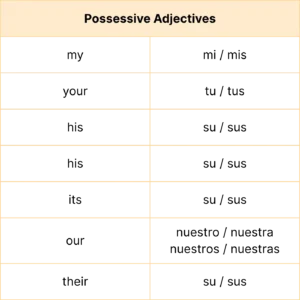
Ejemplos:
- I love my family. → Amo a mi familia.
- Where is your homework? → ¿Dónde está tu tarea?
- He always forgets his keys. → Él siempre olvida sus llaves.
- Maria is talking to her teacher. → María está hablando con su maestro / maestra.
- The cat is eating its food. → El gato está comiendo su comida.
- We are playing with our cousins. → Estamos jugando con nuestros primos / nuestras primas.
- They are selling their house. → Ellos están vendiendo su casa.
Reglas rápidas para recordar
- Siempre coloca el possessive adjective antes del sustantivo.
- No uses ‘s después de un adjetivo posesivo. (
 my’s book)
 - “Its” (sin apóstrofo) muestra posesión, mientras que “it’s” = it is.
¡Hora de practicar!
Completa los espacios con el adjetivo posesivo correcto:
- This is ___ (I) chair.
- That is ___ (she) phone.
- Where is ___ (we) teacher?
- They are cleaning ___ (they) room.
- He is eating ___ (he) sandwich.
Resumen
- Possessive adjectives = my, your, his, her, its, our, their
- Sirven para mostrar a quién pertenece algo.
- Siempre van antes de un sustantivo.